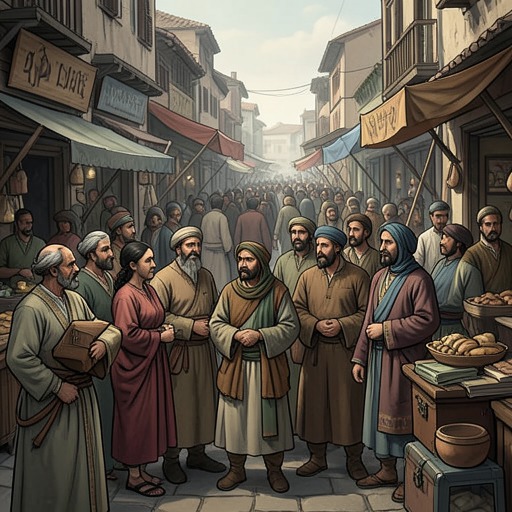
turning the world upside down
Acts of the Apostles“Turning the world upside down” is an accusation made against Paul and Silas in Thessalonica, where opponents portray their preaching as a threat to Roman order. The commentary holds the charge in tension: it is false as a claim of political rebellion, yet it points to the disruptive consequences of announcing the Realm and the end of the old age.
The Accusation in Thessalonica
After Paul and Silas preach in the synagogue, some of their opponents recruit ruffians and set the city into an uproar while searching for them. Unable to find the two witnesses, the crowd attacks Jason’s house, which may have served as a house-church, and brings Jason before the authorities. The charge is that Paul and Silas have been “turning the world (oikoumenē) upside down” and claiming that Jesus should be the emperor.
The phrase has a pointed political setting. Although Christians today may use “turning the world upside down” approvingly, in this episode it is an accusation of disturbing the peace of the Roman empire. The disorder in the city is caused by the mob, not by the disciples, and the movement has no plan to dethrone Caesar.
False Charge and Deeper Meaning
The commentary reads the accusation on two levels. At the immediate level, its allegations misrepresent both the source of the disturbance and the movement’s political aims. Paul and Silas are not organizing an attempt to take Caesar’s place in Rome.
At the theological level, however, the witness does unsettle the old age: it announces that the existing world is ending and will be replaced by the Realm. Jesus’ rule is not a claim to replace Caesar as Rome’s emperor; it is described as rule from the right hand of God. The distinction allows the text to reject the mob’s account without treating the proclamation as harmless to established power.
The Expression as Social Critique
The charge captures a recurring conflict between Realm-like values and institutions invested in the old age. Those entrenched in existing arrangements may perceive such values and practices as threats to order. For people caught up in the Realm’s vision, by contrast, the breakdown of repressive, exploitative, unjust, and violent systems is not merely a disturbance of the peace but part of social transformation.
The expression therefore carries both an accusation and an unintended insight. It falsely casts the witnesses as agents of civic disorder, while recognizing that their message challenges the order they are accused of disturbing. In the Thessalonian episode, Roman legal procedure results in Jason providing bail and being released; the witnesses leave the city at night and travel to Beroea.